
Zakynthos in the Second World War

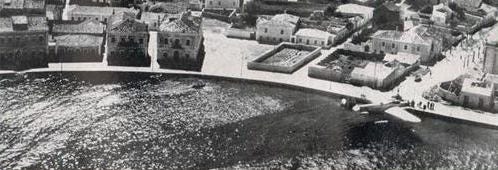
On the 30th April 1941, a Cant-Z-506B seaplane was spotted in Kefalonia’s harbour by Greek residents. The plane was piloted by Italians and its arrival was the start of the Italian invasion of Kefalonia during World War Two. The plane was one of five seaplanes that had taken off from Brindisi, and they were followed by three transport aircraft containing sixty Italian parachutists.
On the 01 May 1941, two Cant-Z-506B seaplanes landed at Zakynthos. More Italian troops swiftly followed, landing on the island by boat, formally occupying the small Ionian island. It was a day islanders had dreaded. Zakynthos and its residents had no choice but to “fall” to the Italian soldiers, becoming part of the ever-growing list of occupied territories overseen by the Axis powers. The island of Zakynthos and her neighbouring Ionian islands remained prisoners of the Italians, until fascism fell in 1943. Hopes were high of the war ending in 1943 but things didn’t get better for Greece. They were quickly invaded by the Germans and much of Greece, including Zakynthos, found itself under German occupation by September 1943. The war continued to rage on and Zakynthos wasn’t liberated from its captors until the 12th of September 1944.
During World War Two occupation Italian soldiers based themselves in Zakynthos Town. They brought in numerous laws that included no cigarettes or tabacco to be brought to Zakynthos without permission, they forbid sale of wheat, no islander was allowed to keep weapons and it was illegal for Zakynthians to write cheques. Italians created their own stamps and money too. Italian soldiers regularly searched homes and any weapons, food, oil, or wheat discovered by the soldiers was immediately confiscated. The Italian Army received daily supplies of food and other items, but they were for army use only and not for Zakynthians.
The German Headquarters were located in Kipi, but they also had bases throughout the island, if the Germans chose to use a property already owned by a Zakynthian family, the family were forced to hand the house and its belongings over to the enemy. The only place on the island free from Germans and Italians was the mountains, which was a Resistance stronghold.
If islanders had thought the Italians were bad, life under the Germans were much worse. They stole from locals, disallowed them to cultivate their own food, were inhumane in their general behaviour, rounded up locals and even killed them for no reason, and they also regularly abused women. Zakynthians did their best to resist their captors and the Resistance movement was strong, made up of both men and women.
Based in the mountains The Resistance fought hard against the Italians and Germans whenever possible, but it wasn’t easy, and many paid for their bravery with their lives if caught. The Resistance received news of the war by using hidden radios and connections with newspapers in Athens, which allowed them to plan movements against their captors. Life on Zakynthos during the war was incredibly hard. Food was sparse, the Germans ruthless and many islanders had to sell belongings, including furniture and jewellery just to survive. Many went hungry, and life was lived on a continual knife-edge of hunger, desperation and fear. Zakynthians were monitored wherever they went, there was no work as companies were forced to close, and many islanders ended up begging for food or buying it on the black market just to survive.
There are many stories of Island bravery. Men and women who did their best to protect their own, who tried to stop the Germans from looting, stealing and abusing residents, who fought hard against their oppression whenever they could. Some were successful, others were not.
The bravest story of Zakynthos during World War Two is the story of Bishop Chrysostomos and Mayor Loukas Karrer. On 09 September 1943, Commandant Berrenz, the German Commandant of Zakynthos at the time, demanded a list of all Jewish island residents from Bishop Chrysostomos and Mayor Loukas Karrer. The Mayor and Bishop presented Commandant Berrenz with a list of just two names; their own. They refused to give up the Jewish population and went as far as protecting and hiding all 275 Jewish island residents, with help from The Resistance. The bravery of the Mayor and Bishop saved many lives and ultimately saw them become heroes of the war. A lasting memorial to them now stands in Zakynthos Town in the remains of the Jewish Synagogue.
Nowadays there isn’t much evidence of the war on Zakynthos, but if you know where to look there are still a few small signs. The main Zakynthos airport is situated on the site of the original airfield constructed by the Italians. It was built not long after they arrived so that troops, weapons and ammunition could be flown to the island rather than bringing them by boat. In the north at Exo Hora there is an old Venetian watchtower that was used by the Italians as a base. A smaller watchtower, also used as a lookout, is situated on the east coast at Kipseli. A few World War Two ruins, such as a stone gun placement still exist on the south east of the island but the German pillbox on the cliffs at Kalamaki has now fallen into the sea. Remains of German fortification are also rumoured to be found at the north of the island. At Kampi there is also a large cross dedicated to those who lost their lives during both World War Two and the Civil War that followed. Ask any local though, and they can give you information about specific places on the island that have stories of the war associated with them.
Much of what happened on Zakynthos during World War Two now lives in the minds, hearts and accounts of those who lived through it, and sadly they are becoming fewer as time passes. We should never forget that the island is what it is today because of the bravery of those who fought hard for their families, their island and ultimately, their freedom.
This article was originally written in 2014 as part of the publication of my book Among the Olive Groves.